
https://www.safybox.com/modules/iqithtmlandbanners/uploads/images/6a86ce8adefa1.jpg
Condensation in electrical enclosures: why IP66 does not control the dew point

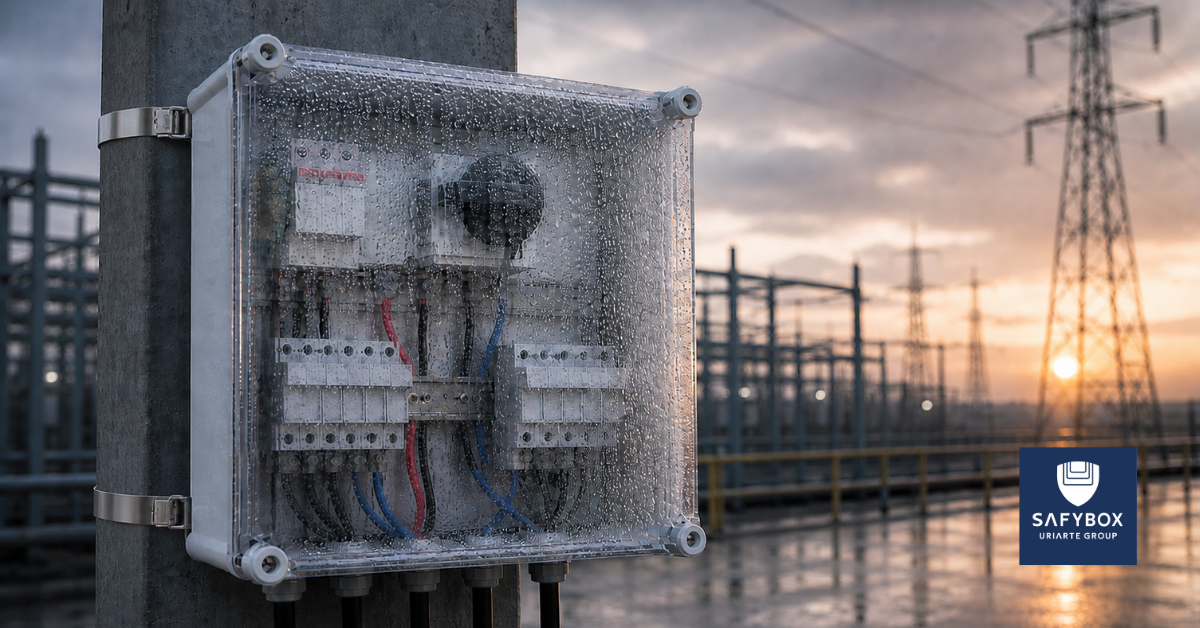
Finding water inside an enclosure with a high IP rating does not, in itself, prove a sealing failure. IP rating and condensation risk are governed by different phenomena.

In outdoor installations, temperature, humidity and dew point can cause condensation even in enclosures with a high IP rating.

Opening an electrical enclosure and finding water droplets inside almost always leads to the same suspicion: “water is getting in”.

It may be. A deteriorated gasket, an incorrectly installed cable gland, a perforation or an improper closure should always be ruled out. But these are not the only possible causes.

In an enclosure installed outdoors, water can also originate within the enclosed air volume itself when an internal surface cools below the dew point. In that case, we are dealing with a different phenomenon from the one assessed by the IP rating.

Water inside the enclosure does not automatically mean that there is a leak. Before looking for where water is entering, it is necessary to determine where it is forming.

Could your enclosure be at risk of condensation?

Assess your installation conditions by answering 8 questions and obtain an indicative evaluation of the risk level.

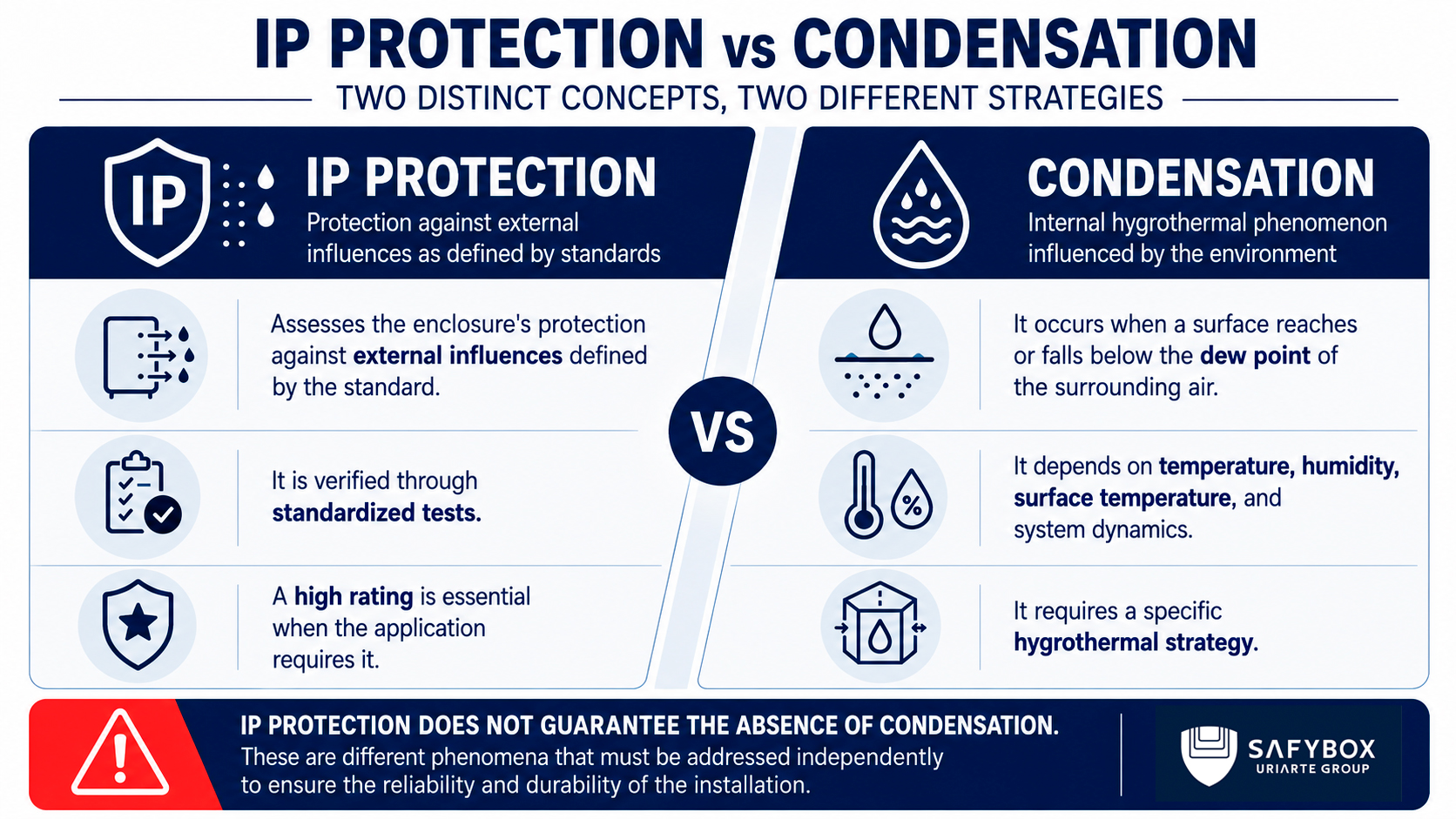
IP rating and condensation answer different questions

An IP66 rating provides very specific information about the protection offered by an enclosure against access, solid foreign objects and external water, in accordance with the tests defined in UNE-EN 60529. The UNE-EN 60529:2018 version remains in force and was confirmed by UNE in December 2025.

What the IP code IP should not be interpreted as is a certification that condensation will never occur inside the enclosure.

In fact, standards address the two phenomena through different test methods. UNE-EN IEC 60068-2-30:2025 specifies a cyclic damp heat test of 12 h + 12 h; the IEC explicitly explains that the test combines high humidity with cyclic temperature variations and that, in general, these conditions cause condensation to form on the surface of the specimen.

A high IP rating protects against the tested ingress conditions. By itself, it does not control wall temperature or the dew point of the air inside the enclosure.

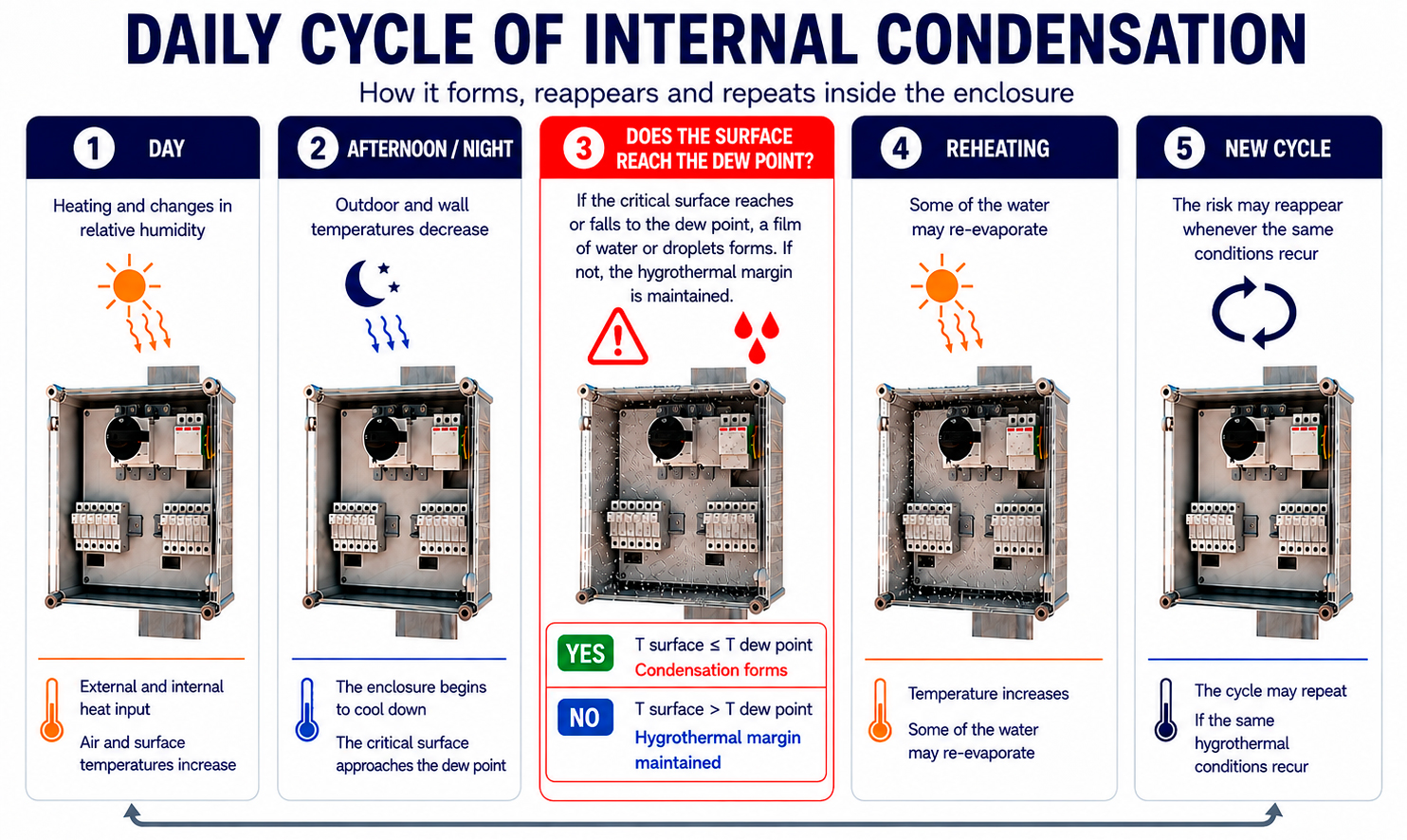
The critical cycle usually occurs when the enclosure wall cools before the air inside

Outdoors, the enclosure forms part of a dynamic thermal system.

During periods of solar radiation, the external surface, the internal air volume and the components themselves can all heat up. As ambient temperature falls, solar radiation changes, shade appears, rain begins or night falls, the different masses and materials do not cool at exactly the same rate.

For this reason, what really matters is not simply recording the air temperature inside the enclosure, but determining the temperature reached by the most critical internal surface and comparing it with the dew point. Temperature and humidity cycles are precisely the mechanism reproduced by the cyclic damp heat tests specified in IEC 60068-2-30

The physical sequence can be summarised as follows:

How to reduce the risk of condensation in an electrical enclosure

Condensation cannot be controlled simply by increasing the IP rating. To reduce its occurrence, it is necessary to address the conditions that determine the hygrothermal balance inside the enclosure: temperature, relative humidity and surface temperature.

The first step is to understand the actual installation conditions and determine the dew point. If an internal surface reaches or falls below this temperature, there is a risk of condensation.

From that point onwards, the strategy should be defined according to the specific application:

01

Thermal control

Maintain an internal temperature sufficiently above the dew point through proper thermal management and, where necessary, anti-condensation heating systems.

02

Humidity control

Assess the internal relative humidity and avoid conditions that promote recurring accumulation of water vapour.

03

Pressure equalisation and ventilation

Where installation conditions allow, use ventilation or pressure equalisation solutions specifically designed to maintain the required level of protection.

04

Installation and maintenance

Check gaskets, closures, cable glands, machining and cable entries. Before attributing observed water to condensation, external water ingress must first be ruled out.

05

Enclosure design

Volume, equipment heat load, solar exposure, orientation, material and environmental conditions must be considered together.

There is no universal anti-condensation solution: the appropriate solution depends on the specific thermal and environmental balance.

The question, therefore, is not simply whether the enclosure has an IP66 rating. The question is whether, under actual operating conditions, any of its internal surfaces can reach the dew point.

Could your enclosure be at risk of condensation?

Assess your installation conditions by answering 8 questions and obtain an indicative evaluation of the risk level.

SAFYBOX URIARTE: Over 50 years perfecting glass-reinforced polyester (GRP)

The real performance of an enclosure does not depend solely on the material, but on the expertise applied to its design, formulation and manufacturing process.

In the case of GRP, factors such as thickness, resin composition and protective additives directly influence its long-term performance.

Specialised European manufacturers such as SAFYBOX URIARTE have built their expertise around this material over decades, developing solutions for industrial environments where durability and structural stabilityl are key requirements.

Since 1972, as a European manufacturer specialising exclusively in industrial glass-reinforced polyester enclosures, the company has not followed passing trends. It has developed and refined this material until it has become the technological core of its industrial identity..

And in industry, accumulated expertise is what truly makes the difference.

LATEST POSTS

Comments (0)

No comments at this moment
Product added to wishlist
Product added to compare.

iqitcookielaw - module, put here your own cookie law text